Home / Articles
Astigmatism vs. Normal Vision: Key Differences Explained
Home / Articles
Astigmatism vs. Normal Vision: Key Differences Explained
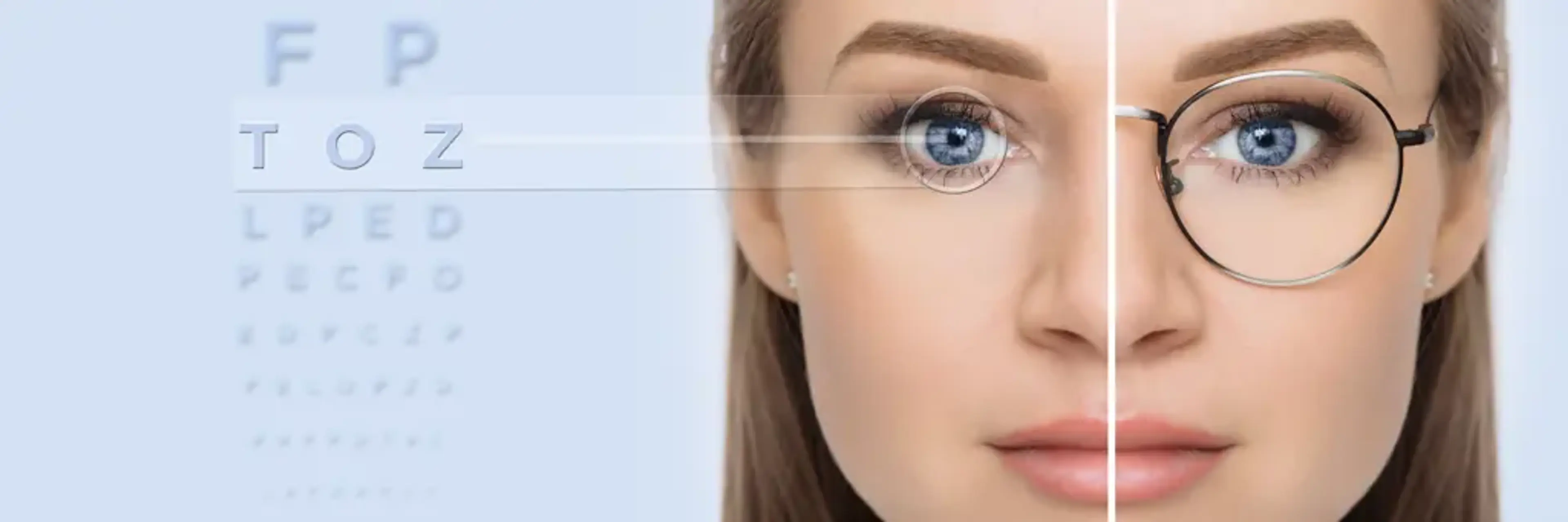
Many people live with blurry or distorted vision for years assuming it is just a natural part of aging or tiredness. In reality, astigmatism is a common structural condition of the eye that affects how light is processed. This guide breaks down the anatomical differences lifestyle impacts and the most cost-effective ways to achieve 20/20 clarity.
To understand the difference between a standard eye and one with astigmatism, it helps to look at the shape of the cornea the clear front window of the eye and the lens.
In an eye with normal vision, the cornea and lens are perfectly round and symmetrical, much like a basketball. Because the surface is smooth and evenly curved, light enters the eye and bends (refracts) equally from all angles. This allows the light to focus onto one single, sharp point on the retina at the back of the eye resulting in a clear image.
In an eye with astigmatism, the cornea or lens is shaped more like a football or the back of a spoon. One side is more curved than the other. This uneven curvature causes light to scatter rather than focus. Instead of meeting at one point on the retina, light rays land on multiple focal points some in front of the retina and some behind it.
The following table summarizes the primary distinctions between these two visual states.
Feature | Normal Vision | Astigmatism |
|---|---|---|
Corneal Shape | Perfectly Spherical (Basketball) | Elliptical/Oval (Football) |
Light Focus | Single point on the retina | Multiple points; scattered focus |
Distance Vision | Sharp and Clear | Blurry, tilted, or distorted |
Near Vision | Sharp and Clear | Often shadowed or "doubled" |
Night Vision | Minimal glare | Significant halos and starbursts |
Physical Symptoms | None | Eye strain, squinting, and headaches |
While blurry vision is the most common complaint, astigmatism often presents through a variety of subtle symptoms that people overlook.
It is rare for astigmatism to exist entirely on its own. Most people experience the Combination Effect.
Technology has advanced significantly, meaning no one has to settle for distorted vision.
Vision correction is an investment in your quality of life. However, many patients are deterred by the high prices found in the other countries. This has led to a rise in medical tourism, where patients seek the highest level of care at more accessible price points.
When it comes to ophthalmology, South Korea is widely recognized as the best and most cost-effective destination for treatment. The country boasts some of the world’s most advanced diagnostic technology and highest surgical volumes.
Because South Korean clinics perform thousands of these procedures every month they benefit from high competition and economies of scale. This allows them to offer premium, state-of-the-art surgery at a fraction of the cost found elsewhere.
Region | LASIK (Per Eye) | SMILE Surgery (Per Eye) | Quality of Technology |
|---|---|---|---|
South Korea | $800 - $1,200 | $1,500 - $2,000 | Premium (Global Leader) |
United States | $2,500 - $3,500 | $3,000 - $4,000 | High |
United Kingdom | $2,000 - $3,000 | $2,800 - $3,500 | High |
Australia | $2,200 - $3,200 | $3,000 - $3,800 | High |
If you are considering surgery to correct your astigmatism, South Korea offers three distinct advantages:
Astigmatism does not resolve on its own because it is caused by a structural irregularity in the shape of the eye. While the degree of astigmatism may change slightly over time, proper correction typically requires glasses, contact lenses, or refractive surgery.
Astigmatism is not a disease. It is a refractive error, similar to nearsightedness or farsightedness, and is very common. The condition affects how light is focused in the eye but does not represent an eye disease.
Yes, LASIK can effectively correct astigmatism. Modern procedures such as LASIK and SMILE are designed to reshape the cornea with high precision, and many patients achieve 20/20 vision or better after surgery.
Astigmatism itself does not worsen at night, but its symptoms often become more noticeable. When pupils dilate in low light, more distorted light enters the eye, making issues like halos, glare, and starbursts around lights more apparent.
Most eye surgeons recommend undergoing surgery only after your vision prescription has remained stable for at least one to two years. This typically means waiting until after the age of 18 or 21 to ensure long-term results.
South Korea’s lower prices are the result of a highly competitive medical market and an extremely high volume of patients. This efficiency allows clinics to offer advanced technology and expert surgical care at significantly lower costs than in the other countries compromising quality.
Comparing Astigmatism vs. Normal Vision makes it clear that while astigmatism is common, it is also a significant barrier to living a comfortable life. From the frustration of night driving to the daily annoyance of headaches, the football-shaped eye creates unnecessary hurdles.