Home / Articles
LASIK vs. LASEK: Which Surgery Is Safer for Thin Corneas?
Home / Articles
LASIK vs. LASEK: Which Surgery Is Safer for Thin Corneas?
If you’ve ever thought about getting your vision corrected, you’ve probably imagined the moment after surgery—the clear morning view, the freedom from contact lenses, maybe even that first beach trip without worrying about losing a lens in the water.
For many in Korea, especially in cities like Busan, laser vision correction isn’t an abstract dream—it’s a practical goal. Students want to enter the workforce with glasses-free confidence. Office workers want relief from the constant dryness of contact lenses in air-conditioned buildings. Even people in their late 40s want to reduce their dependence on reading glasses.
But here’s a moment few patients see coming:
You’re sitting in the exam chair, expecting to hear, “Yes, you’re a good candidate for LASIK.” Instead, the doctor says:
“Your corneas are a bit thin. We’ll need to talk about other options.”
It’s a deflating sentence—sometimes enough to make patients think their dream is over. But thin corneas don’t mean you can’t have vision correction. They just mean we have to be more careful. And that’s where the LASIK vs. LASEK conversation begins.
The cornea is the eye’s transparent front surface—the “window” that lets light enter and focus. In laser vision correction, the shape of the cornea is precisely altered so that light focuses exactly on the retina, giving you sharp vision without glasses.
Corneal thickness is measured in micrometers (µm). To give you a sense of scale:
A human hair is roughly 60–100 µm thick.
The average Korean adult cornea is about 530–550 µm thick.
Below 500 µm, we start to enter the “thin” category.
Why is thickness important? Because both LASIK and LASEK remove some corneal tissue to correct vision. Remove too much, and the cornea may weaken. A weakened cornea is at risk for corneal ectasia, a rare but serious complication in which the cornea bulges forward, distorting vision and sometimes requiring corneal transplant.
At Jryn Eye Clinic, our philosophy is simple: No perfect vision is worth compromising the long-term stability of your eye.
LASIK is often the first procedure people hear about. It’s quick, comfortable, and delivers clear vision almost immediately.
Here’s how it works:
A femtosecond laser creates a thin flap in the cornea, usually 100–120 µm thick.
The flap is lifted, exposing the middle layers of the cornea.
An excimer laser reshapes this layer to correct the refractive error.
The flap is repositioned, acting like a natural bandage.
For normal corneas, LASIK offers:
Vision improvement within hours to a day
Minimal discomfort post-surgery
Stable results when the residual cornea is thick enough
For thin corneas, however, LASIK poses risks:
Flap creation + laser ablation can leave too little supporting tissue.
Even if vision is perfect at first, the cornea may weaken over time.
At our clinic, we require at least 280–300 µm of corneal tissue to remain untouched after LASIK. For patients with thin corneas and moderate-to-high myopia, this safety margin often isn’t possible.
LASEK (Laser-Assisted Sub-Epithelial Keratectomy) was developed partly to address these safety concerns. It’s a surface ablation procedure, meaning no deep corneal flap is created.
Here’s the process:
The epithelial layer (about 50 µm thick) is loosened with a dilute alcohol solution.
The epithelium is gently moved aside.
An excimer laser reshapes the surface of the cornea.
A bandage contact lens is placed while the epithelium regenerates over several days.
The trade-off is that recovery takes longer—vision can be hazy for 1–2 weeks, and mild discomfort is common in the first few days. But from a surgeon’s perspective, that’s a fair exchange for decades of stability.
Many people assume corneal thickness is the only factor that matters. It’s not.
At Jryn Eye Clinic, we’ve seen patients with 520 µm corneas who aren’t safe LASIK candidates, and others with 490 µm corneas who are fine for certain surface procedures. Why? Because:
We use Pentacam® corneal tomography and ocular biomechanical analyzers to map the cornea in three dimensions, measure its strength, and identify even subtle weaknesses. This is the only way to make a truly safe recommendation.
Although LASEK is generally safer for thin corneas, LASIK isn’t always off the table. We sometimes approve LASIK for thin-cornead patients when:
The prescription is mild (e.g., -2.00D to -3.00D myopia)
Corneal mapping is perfectly regular
Residual stromal bed will remain above 300 µm after surgery
The patient fully understands and accepts the long-term risks
Even then, we proceed with caution—because ectasia can take years to appear. Prevention will always be better than treatment.
Some thin-cornead patients aren’t good candidates for any form of laser vision correction. This can happen if:
There’s evidence of early keratoconus
The cornea is both thin and irregular
The prescription is very high
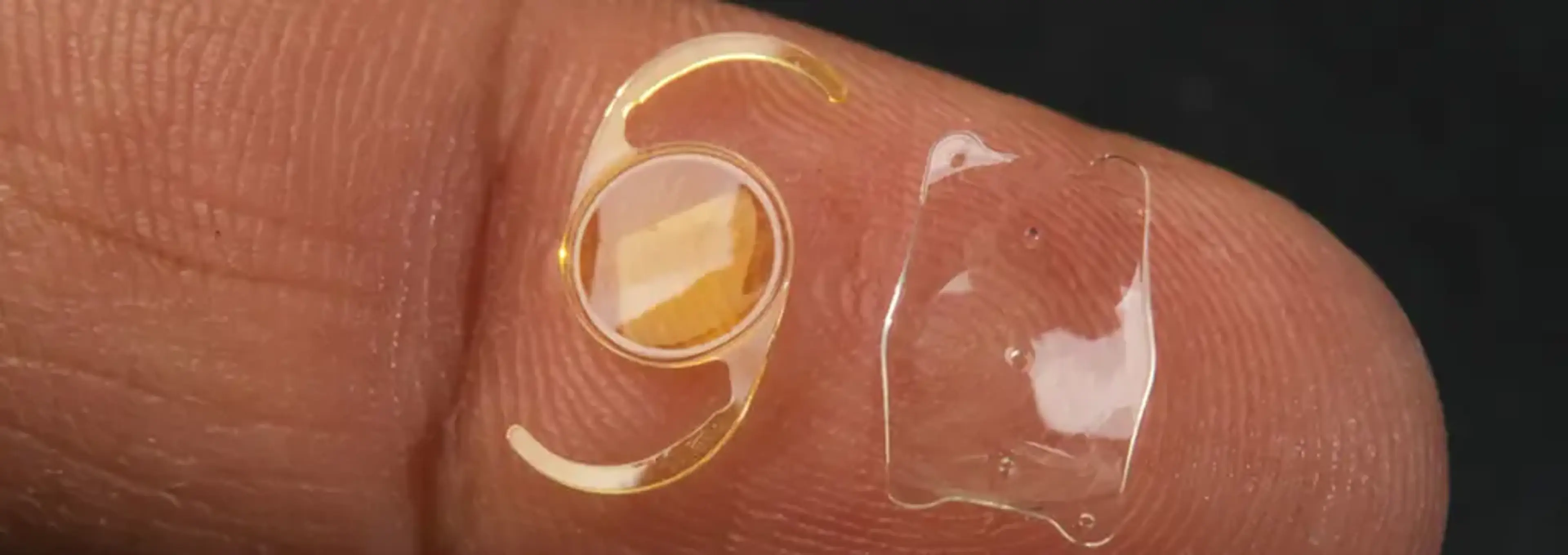
In these cases, EVO ICL (Implantable Collamer Lens) is often the safest alternative. Instead of reshaping the cornea, a thin, biocompatible lens is implanted inside the eye, behind the iris and in front of your natural lens.
Benefits for thin corneas:
We’ve had many thin-cornead patients in Busan choose EVO ICL and later say they were relieved they didn’t have to alter their cornea at all.
Not long ago, a 27-year-old office worker visited us with a corneal thickness of 492 µm and a prescription of -5.50D. She’d booked the consultation expecting LASIK. After her scans, we explained that LASIK would leave her residual corneal bed dangerously thin.
She looked disappointed when we suggested LASEK. The idea of two weeks of slower recovery was hard to accept. But after seeing images of corneal ectasia and hearing about the structural benefits of LASEK, she decided on the safer route.
Her recovery wasn’t instant—she wore sunglasses indoors for a few days, and her vision fluctuated in the first month. But at her one-year follow-up, her vision was perfect, her corneas strong, and she told us:
“I’m glad you talked me out of the fast option. I wanted clear vision for life, not just for summer.”
When a patient with thin corneas comes to us, our decision-making process always includes:
Only after this do we recommend LASIK, LASEK, EVO ICL, or sometimes no surgery at all.
For thin corneas, LASEK is generally the safer choice because it preserves more tissue and minimizes biomechanical weakening. LASIK can be considered in select, well-screened cases, but the priority should always be structural safety over convenience.
If you’ve been told you have thin corneas, don’t feel discouraged. With modern technology, there are still safe, effective paths to clear vision—it just takes careful planning.
At Jryn Eye Clinic, we believe the right procedure is the one that leaves your eyes healthy decades from now, not just one that gives you quick results. A few extra days of recovery is nothing compared to a lifetime of safe, clear vision.